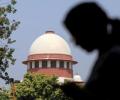
The Supreme Court of India has upheld the Election Commission's documentation framework for the Special Intensive Revision of electoral rolls, affirming the commission's authority and stating that Aadhaar is not proof of citizenship.

Amid the passport row, Shashi Tharoor has proposed legal changes to simplify proof of Indian citizenship.

The Supreme Court has sought responses from the Centre and States regarding a plea alleging the misuse of Aadhaar cards as proof of citizenship, domicile, and residential address. The petition argues that despite legal provisions, Aadhaar is being used for purposes beyond identity verification, potentially aiding illegal immigrants, and calls for a comprehensive overhaul of electoral verification processes.

A clarification by the ministry of external affairs that the passport is not a proof of citizenship has once again brought to the fore the need for a legal framework to provide citizens with a single document to establish they are Indians.

Government sources have clarified that a passport has never been considered proof of citizenship in India, a stance consistent for the past 12 years and rooted in the Passport Act 1967. This clarification, reiterated by the Ministry of External Affairs, has drawn criticism from opposition leaders and public figures.

A 24-year-old woman of Bangladeshi origin was arrested in Rishikesh for allegedly living in India with forged documents. Police seized a fake Aadhaar card and other documents.
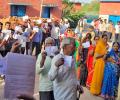
The Supreme Court has directed the Election Commission to include Aadhaar as a valid document for voter identification in Bihar's special intensive revision of electoral rolls, clarifying it is not proof of citizenship.

Police in Haridwar, Uttarakhand, have arrested a Bangladeshi woman for allegedly residing illegally in India using counterfeit documents. An Indian man has also been detained for providing her with shelter and assisting her in obtaining the fake documents.

The Bombay High Court ruled that possessing documents like Aadhaar, PAN, or voter ID does not automatically grant Indian citizenship, emphasizing the importance of the Citizenship Act of 1955.
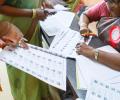
The Supreme Court of India resumed hearing petitions challenging the Special Intensive Revision of electoral rolls in Bihar, addressing the use of Aadhaar and concerns about voter deletions.
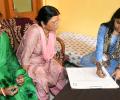
'40 percent of voters in Bihar will be excluded.'

After being wrongly deported and labelled as Bangladeshis, migrant workers in West Bengal's Murshidabad are heading to the polls to reclaim their Indian identity and fight for their right to belong.
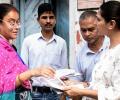
Thousands of West Bengal residents whose names were deleted from electoral rolls are awaiting decisions from tribunals, the final recourse after initial appeals were rejected. The fate of around 2.3 million people hinges on these adjudications, raising concerns about voting rights and citizenship.
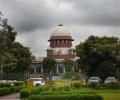
The Supreme Court has reserved its verdict on a petition challenging the Special Intensive Revision (SIR) of electoral rolls in Bihar, following arguments from various lawyers and the Election Commission of India.

The Election Commission of India defends its Special Intensive Revision of electoral rolls in Bihar, stating it enhances election purity by removing ineligible voters. The commission addresses concerns about Aadhaar usage, emphasizing its limited role in identity verification during the SIR-2025 exercise.

Underscoring the 'presumption of genuineness' of Aadhaar and voter ID, the Supreme Court on Monday refused to stay the publication of draft electoral rolls in poll-bound Bihar and said it would once and for all decide pleas against Election Commission's special intensive revision (SIR) of electoral rolls.

The Supreme Court is examining the validity of the Election Commission's decision to conduct special intensive revisions of electoral rolls in several states, focusing on concerns about democratic participation and the burden on ordinary voters.
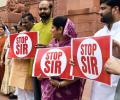
The Supreme Court has warned that it will set aside the special intensive revision (SIR) of electoral rolls in Bihar if any illegality is found. The court is reviewing the validity of the Bihar SIR and its potential impact on a similar exercise across India.

The central government has provided armed security to West Bengal's Chief Electoral Officer following potential threats related to the ongoing Special Intensive Revision of electoral rolls.

Hearings under the Special Intensive Revision (SIR) of electoral rolls were underway in West Bengal, focusing on 'unmapped' voters who are unable to establish linkage with the 2002 electoral roll. Many people are being asked to prove their citizenship.
Special Intensive Revision (SIR), the Election Commission's voters' list cleanup exercise, will commence in nine states and three Union territories from Tuesday.
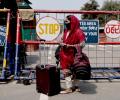
The Supreme Court on Friday directed authorities not to deport to Pakistan six members of a family, who allegedly overstayed their visa, till their citizenship claim is verified.

Family members of a Kargil war veteran in Pune allege harassment and demands for citizenship proof by a Hindutva group, accusing them of being Bangladeshis. Police deny a large group barged into the house, but confirm document verification.
A bench of Justices Sudhanshu Dhulia and Joymalya Bagchi, however, questioned the timing of the exercise, besides offering its prima facie view that Aadhaar card, voter ID card and ration cards could be considered during the SIR in Bihar.

Sharada Kukreja, a Pakistani woman living in Odisha for 35 years after marrying an Indian citizen, has been served a notice to leave the country. She has appealed to Prime Minister Narendra Modi and Odisha CM Mohan Charan Majhi to stop her deportation, citing her long-standing ties to India and family here. Sharada fled Pakistan to escape forced conversion and marriage, and despite having an Aadhaar card and participating in elections, she has not been granted Indian citizenship. The Odisha government has identified 12 Pakistani nationals residing in the state and asked them to leave by April 27. Another Pakistani woman in Bhubaneswar also received a country exit permit on Saturday.

This is likely to put a brake on the fast pace at which Aadhaar cards have been issued so far to more than 400 million people.
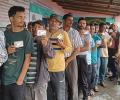
The Supreme Court has directed the Election Commission of India (ECI) to publish details of deleted names from the voters list in Bihar, along with reasons for non-inclusion, to enhance transparency in the special intensive revision (SIR) of the electoral roll.

The All India Matua Mahasangha has asked its members to apply for Indian citizenship only after the formation of a new government at the Centre.
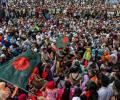
A fresh political row has erupted in West Bengal after a person allegedly involved in Bangladesh's August 2024 student protests was found listed as a voter in Kakdwip, triggering sharp Bharatiya Janata Party-Trinamool Congress exchanges over alleged illegal infiltration and manipulation of the voter list in the state.
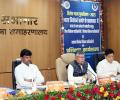
'The Election Commission is conducting the National Register of Citizens in Bihar through the backdoor.'

'Today, the State looks at everyone with suspicion.'
The Supreme Court has stated it will intervene if there is mass exclusion in the special intensive revision of electoral rolls in Bihar, emphasizing the Election Commission's role as a constitutional authority.
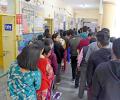
For the first time in their lives, 186 Pakistani Hindu refugees in Delhi cast their votes in the Delhi Assembly polls, marking a significant moment in their journey towards citizenship. Having received Indian citizenship under the Citizenship (Amendment) Act, they expressed hope for a better future with permanent homes and stable livelihoods. The refugees, who have lived in makeshift shelters and struggled with daily wage work for decades, felt a sense of belonging and empowerment after exercising their voting right.
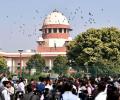
The Supreme Court has begun hearing petitions challenging the Election Commission's decision to conduct a special intensive revision exercise in Bihar ahead of elections, raising concerns about voter exclusion.

A bench of Justices Surya Kant and Joymalya Bagchi is likely to take up the matter in which the EC has justified its ongoing SIR of electoral rolls in Bihar, saying it adds to the purity of the election by "weeding out ineligible persons" from the electoral rolls.

The order also highlights further disparities, citing examples of Denmark and Sweden restricting mail-in voting to those unable to vote in person and rejecting late-arriving ballots regardless of postmark, while many US states have embraced widespread mail-in voting, with some accepting ballots without postmarks or those arriving well after Election Day.

"There is bound to be revision," the top court said, "otherwise, how will the poll panel delete the names of those who are dead, migrated or shifted to other constituencies?"
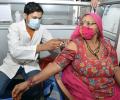
Most of the migrants do not get access to any medical facilities in government-run hospitals or dispensaries as they do not have an Aadhaar card and are not Indian citizens.

The Delhi high court on Tuesday refused to entertain a plea seeking directions to enrol Rohingya refugee children in local schools, saying it was the Centre's domain.

'This updated NPR database along with Aadhaar Number would become the mother database and can be used by various government departments...' the home ministry declared in July 2015. 'UID/Aadhaar has been used as a fish bait to ensnare and entrap present and future generations of citizens,' warns Gopal Krishna.
